Your question is too important for a presentation and too complex for a committee
Your leadership team has tried to answer it in smaller rooms. The presentations were polished. The workshops produced sticky notes. The strategy document is on SharePoint. Nothing has moved.
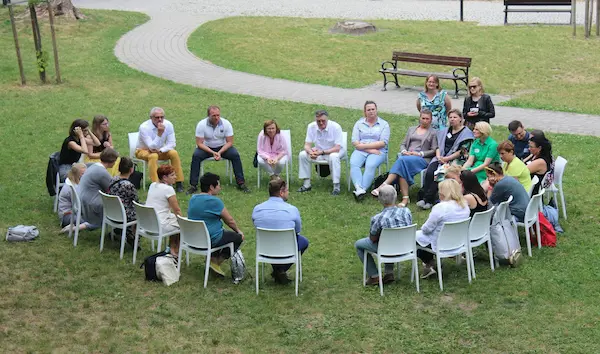
Open Space puts the question back where it belongs: in the room, with all the people who have to live with the answer. One day. No predetermined agenda. Every session documented before people leave.
When should you commission an Open Space event?
Open Space works when the challenge is genuine, the group is large enough to hold diverse perspectives, and leadership is prepared to act on what emerges.
- Your organisation is going through a change that needs real ownership, not announced compliance
- A strategic question has been stuck at leadership level and needs the broader organisation's intelligence
- You are hosting a multi-stakeholder event and want real work to happen, not just speeches
- Groups that do not usually talk to each other need to build shared understanding fast
- 50 to 500 people need to reach shared commitments without a predetermined answer being forced on them
Not sure it fits? Read what Open Space Technology is and when it doesn't work before you decide.
What formats are available?
Half-day — 12 to 50 people
One focused question. Two rounds of parallel sessions. Enough to surface what the group knows but has not said out loud. Good for teams or departments with a challenge that has not been fully explored together.
Full day — 25 to 200 people
The standard Open Space format. Morning: participants post their topics, the agenda fills in ten minutes, sessions run in parallel and people move freely between them. Afternoon: converge, prioritise, and document. You leave with a harvest document the same evening.
Two days — 50 to 500+ people
For strategic processes, large conferences, or multi-stakeholder change work. The first day opens the space. Overnight, the group's thinking evolves. The second day goes deeper and closes with clear commitments and owners.
Virtual and hybrid
Open Space works online. It needs the right setup — breakout rooms that feel like real rooms, a shared documentation space, and a facilitator who can hold energy across a screen. It is not the same as in-person. It does produce real work.
What is the most important design decision?
A weak question produces polite sessions. A strong question produces the conversations people needed to have but never had the space for.
The question needs to be open enough that participants can take it anywhere, and focused enough that everything that emerges is relevant. We work with you before the event to get this right. It usually takes two or three iterations.
Questions that work
- "What do we need to stop, start, and change to be the organisation we want to be in five years?"
- "What is getting in the way of working together — and what would actually help?"
- "What opportunities are we not seeing because we are too busy protecting what we have?"
- "What would make this merger work — and what is already getting in the way?"
Questions that do not work
- "How do we implement the new strategy?" — already has an answer, just needs communication
- "What do you think about our new values?" — too closed, invites theatre not thinking
- "How can we improve performance?" — too broad to focus energy
What we do before, during, and after
Our job is to design and hold the container — not to control the content. The group does the work. We make sure the conditions are right for that work to happen.
Before
- We talk to the key people involved to understand what is really going on beneath the surface question
- We write the central question together — the invitation that opens the space
- We prepare the room setup and brief participants so they know what to expect
- We advise on who should be in the room and who should be invited to post topics
During
- We open the space — explain the format, the principles, the Law of Two Feet
- We hold the container: visible enough to maintain energy, absent enough to let self-organisation work
- We ensure every session is documented before people move on
- We close the space: help the group see what emerged and what it means
After
- We compile the full harvest document — every topic, every session summary, every commitment made
- We deliver it within 24 hours
- We debrief with you on what emerged and what needs follow-through
We run sessions in English, Dutch, and French. For multicultural European teams, this matters — people think differently in their own language.
What does Open Space look like in practice?
Strategy launch: from announcement to ownership
A leadership team had spent months writing a new strategy. They did not want to announce it and hope people would follow. They wanted people to own it.
One day of Open Space. The question: "What do we need to make this strategy real — and what is already getting in the way?" One hundred and twenty employees posted 34 topics. By the end of the afternoon, fifteen action groups had formed around the ones that mattered most. Not because leadership asked for them. Because people saw the gap and stepped into it.
The harvest document went to leadership the next morning. The conversations it captured had not happened in four years of quarterly updates.
Cross-sector network: surfacing what blocked collaboration
Eight organisations in the same sector had been trying to collaborate for two years. Progress was slow. Every joint meeting ended with good intentions and no follow-through.
Half a day of Open Space with representatives from all eight. The question was about obstacles, not solutions. What surfaced in the first round had never been said in any formal meeting. By the second round, three working groups had self-organised around the real blockers. Six months later, two of those groups had produced concrete joint outputs.
More about the method: Open Space Technology — principles, formats, and when not to use it
Plan your Open Space event
Tell us what question you are holding. We will tell you honestly whether Open Space is the right format — and if it is, what preparation it needs.
Find an Open Space facilitator
The Belgian Open Space community: openspace-facilitation.eu